Apostille for Bulgarian Documents | Bulgaria Apostille Service for Use Abroad
Bulgarian paperwork is written in Cyrillic, signed by local officials, and stamped with seals that a registrar in Ohio or a notary in Madrid has never seen before. For the receiving side to trust such a record, it usually needs an apostille. Bulgaria has been a party to the 1961 Hague Convention Abolishing the Requirement of Legalisation for Foreign Public Documents since 2001, so a single certificate issued in Sofia or in a regional center is normally all that another member state asks for.
Getting that certificate from abroad is less simple. Bulgaria splits the work among four different bodies, and each one accepts only certain types of papers. A birth record from a small municipality, a university diploma, and a court decision can end up in three different places, even when they belong to one application for a visa or residence permit.
Bulgaria and the Hague Apostille Convention
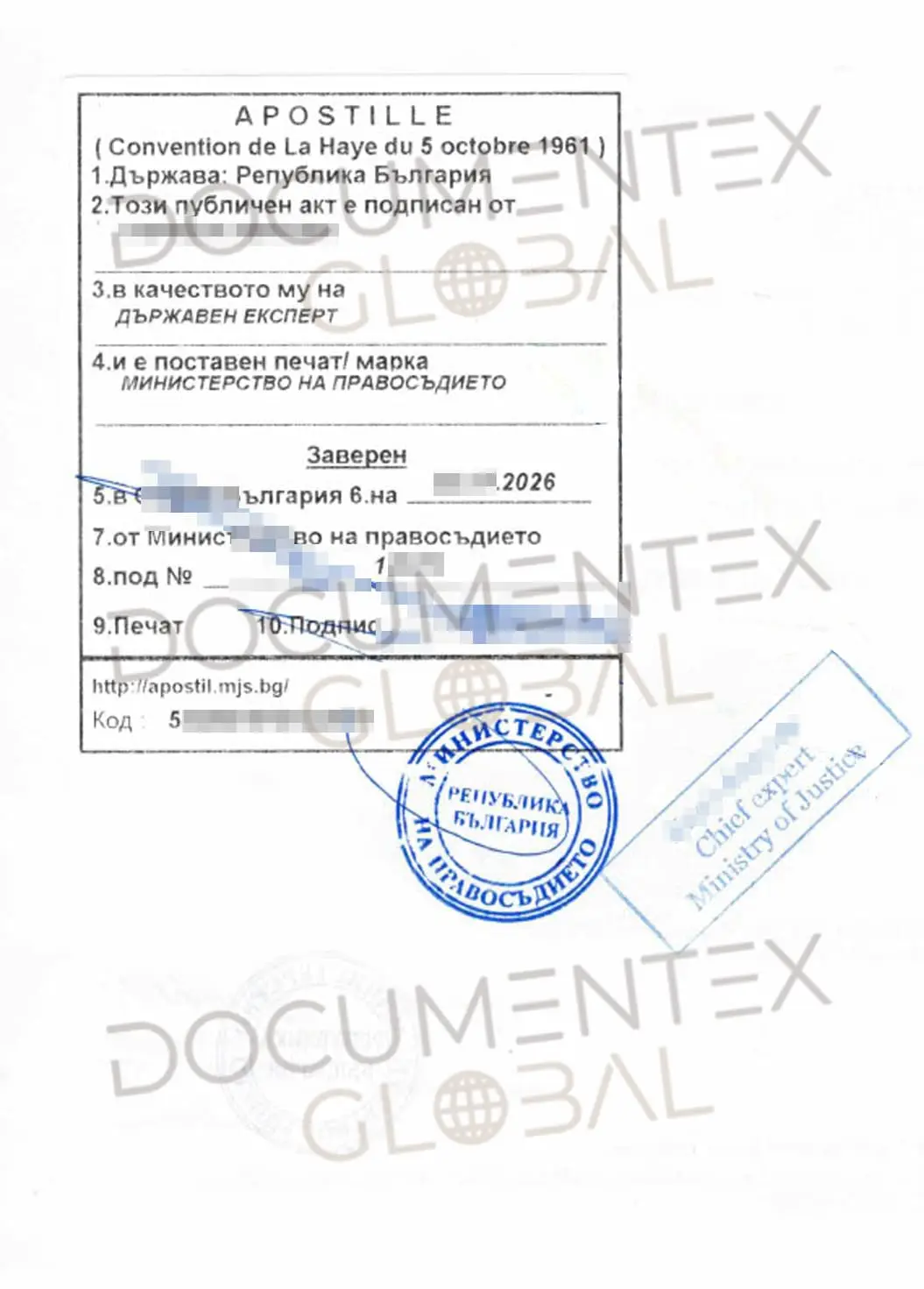
The apostille deals with a particular question: can the overseas institution rely on the official signature appearing on a Bulgarian record? The authority issuing the apostille authenticates that signature, the position in which the official acted, and the accompanying seal or stamp. The certificate is attached to the document so these details can be recognized in another country covered by the Convention.
Consider a marriage certificate issued by a Bulgarian municipality. The apostille makes its official signature recognizable abroad, but it does not confirm the information entered in the marriage register. Whether that particular certificate is sufficient for an immigration application, a name change, or another procedure remains a decision for the receiving authority.
Bulgaria joined the European Union in 2007. For many civil status papers used inside the EU this matters a great deal, as explained further below.
Who Issues an Apostille in Bulgaria
The competent authority is chosen by the type of paper and by the body that signed it. Bulgaria has notified the Hague Conference of four such authorities:
-
Regional administrations (oblastni administratsii) handle documents originating from mayors and municipal offices. Birth, marriage, and death records are usually directed here, since the underlying registrations are maintained locally. The municipality that produced the certificate determines which regional administration is responsible for its apostille.
-
The Ministry of Justice handles court acts and notarial acts: judgments, court decisions, notarized powers of attorney, signature certifications, and similar papers.
-
The National Centre for Information and Documentation (NACID) covers education records issued by universities, schools, kindergartens, vocational institutions, and the Ministry of Education and Science.
-
The Ministry of Foreign Affairs is responsible for eligible official documents that do not belong to the categories assigned to the other three authorities.
All four publish their apostilles in online registers, so a bank or court abroad can look up the certificate number and confirm that it was really issued.
Bulgarian Documents That Can Be Apostilled
If the destination state is a member of the Convention, an apostille can go on any eligible public record issued in Bulgaria. Our clients ask most often for the papers below (the Bulgarian name is given in parentheses where it may be useful when ordering a copy):
-
Birth Certificate from Bulgaria (udostoverenie za razhdane), including duplicates and full extracts from the birth record;
-
Police Clearance Certificate from Bulgaria (svidetelstvo za sadimost);
-
Marriage Certificate from Bulgaria (udostoverenie za grazhdanski brak);
-
Divorce Certificate from Bulgaria and court divorce decisions;
-
Death Certificate from Bulgaria and extracts from the death record;
-
Certificates of family status, current address, and other civil register extracts issued by municipalities;
-
Proof of Bulgarian citizenship and certificates of name identity;
-
University Diplomas, diploma supplements, and Academic Transcripts;
-
School Certificates and diplomas of secondary education;
-
Vocational qualification certificates;
-
Notarial Powers of Attorney (palnomoshtno);
-
Notarized Declarations and Consents, such as a parent’s consent for a minor to travel abroad;
-
Court Judgments, rulings, and certificates of entry into force;
-
Judicial Records and extracts from court case files;
-
Commercial Register extracts and certificates of good standing for Bulgarian companies;
-
Administrative Certificates issued by ministries, agencies, and other state bodies.
Not every paper prepared in Bulgaria qualifies for an apostille in its original form. A private employment reference, for instance, lacks the kind of official certification the apostille is intended to authenticate. The same problem can arise with an agreement signed directly between two businesses.
A Bulgarian notary can provide an appropriate certification of a signature or copy when the procedure allows it. The apostille then relates to that notarial act, rather than independently confirming the statements made in the private document.
Passports and national identity cards themselves are not apostilled. When an institution overseas requires evidence of identity, the applicant should confirm whether a notarized copy is acceptable and what form of certification it expects.
Civil Status Records from Bulgarian Municipalities
Bulgaria has no central registry office for births, marriages, and deaths. The entries are made and stored locally, by the civil registration service of each of the 265 municipalities. Someone born in Plovdiv who later married in Varna therefore has records in two town halls, and the birth certificate goes to the Plovdiv regional administration while the marriage certificate goes to the one in Varna.
Many people keep a birth certificate that was issued when they were children. Some foreign authorities will not accept a paper that old, or they set their own limit on how recent the certificate must be. A duplicate or a new extract can then be ordered from the municipality that holds the original entry, and if you live abroad, a representative with your power of attorney can apply on your behalf.
Ask the receiving office which version it needs before ordering. A Bulgarian municipality can issue a short certificate or a fuller copy of the civil register entry, and the fuller copy carries more details, including later annotations to the entry.
Diplomas, School Records, and the NACID e-Apostille
Bulgaria issues electronic apostilles only for education records. NACID started offering them in June 2020. Each e-Apostille has a QR code, allowing the recipient to check its authenticity online. This gives foreign universities and employers a way to verify the electronic certification associated with an educational record. NACID also provides paper apostilles.
Not every institution abroad accepts the electronic format, and many still ask for a paper original, so check with the recognition body first. Papers handled by the regional administrations, the Ministry of Justice, or the Ministry of Foreign Affairs receive a paper apostille in all cases.
Court Papers, Criminal Records, and Notarial Acts
The Ministry of Justice places apostilles on court acts and notarial acts. In practice that means court decisions in divorce, custody, inheritance, and commercial cases, plus deeds, powers of attorney, and other papers signed or certified by a Bulgarian notary.
Clients ask us for the criminal record certificate (svidetelstvo za sadimost) more than for any court paper. The criminal records bureaus at the district courts issue it, and it is needed abroad for immigration, jobs, adoption, and residence applications. If the destination country requires apostille authentication, the certificate must first be obtained in the appropriate official form in Bulgaria. The application may therefore involve both obtaining the record and arranging its certification. Foreign authorities can also impose their own requirements concerning how recently the certificate was issued.
Bulgarian Names in Latin Script
Bulgarian records give your name in Cyrillic. A translator converts it to Latin letters, and the result does not always match the spelling in your passport, your residence card abroad, or an earlier translation. Bulgaria’s Transliteration Act sets one official system, but older passports and foreign records may use other forms, such as «Jivko» for «Zhivko» or «Gueorgui» for «Georgi.»
The apostille itself is not affected by a spelling difference. The foreign office reviewing your file may still ask about it, though. If you changed your name after marriage or your passport uses another spelling, prepare a short explanation or get a certificate of name identity before you submit the papers.
Translation of Bulgarian Documents After the Apostille
Very few offices abroad can read Bulgarian, so most cases include a translation. Bulgaria has no court-sworn translators. Official translations are done by translators of agencies that have a contract with the Ministry of Foreign Affairs, and the ministry can certify the translator’s signature if this is needed.
Usually the apostille comes first, and then the translator works on the original and the apostille together. Some countries accept a certified translation made in Bulgaria. Others want it done by a sworn translator in their own country, and the receiving office can tell you which rule it applies.
When an Apostille from Bulgaria Is Not Needed or Not Enough
For certain Bulgarian public records, the destination being another EU member state changes the authentication requirements. Regulation (EU) 2016/1191 removes the need for an apostille on documents covering specified matters, such as birth, marriage, divorce, death, name, parenthood, nationality, and residence.
The exemption also extends to certain certificates concerning the absence of a criminal record, provided the conditions of the regulation are met. An applicant may be able to request a multilingual standard form to accompany an eligible civil status document, reducing the need for a separate translation.
These provisions do not cover every category of Bulgarian paperwork. Academic diplomas and company records, for example, are outside this particular regulation. If another EU authority questions the authenticity of a covered certificate, it can seek clarification from the Bulgarian issuing institution through the Internal Market Information System.
Outside the Convention’s framework, an apostille is not necessarily the appropriate form of authentication. Some destinations instead require Bulgarian documents to undergo consular legalization. That can involve certification within Bulgaria followed by further authentication through the destination country’s diplomatic or consular authorities. The procedure should be established for the particular country before the original documents are prepared.
Remote Bulgaria Apostille Service from Documentex Global
Documentex Global obtains apostilles on Bulgarian papers for clients who live abroad and do not want to travel to Bulgaria or contact several government offices on their own.
We begin by identifying the receiving country and reviewing the documents requested for the application. This establishes whether apostille certification, consular legalization, or an applicable EU exemption is relevant.
If the required original is unavailable, we can arrange another official certificate through the issuing municipality, court, or educational institution. The document is then prepared for the Bulgarian authority responsible for its category, whether that is a regional administration, the Ministry of Justice, NACID, or the Ministry of Foreign Affairs.
Translation, notarization, and additional legalization services can be coordinated within the same case. When the documents are ready, we arrange international courier delivery of the originals.
Some information and paperwork will be needed from your side. Depending on the request, this may be your personal details and civil registration data, a copy of your passport or ID card, a signed power of attorney, or the original paper itself.
Whether you are applying for residence, enrolling at a university, getting married, or opening a company abroad, Documentex Global can arrange the apostille for Bulgarian documents remotely, from the first check of your papers to worldwide courier delivery.
About Us
Documentex Global is a professional service specializing in document assistance for people living abroad or going through immigration processes

Minimal Client Involvement

No Personal Presence Required

Save Time and Resources

Reliability and Trust

Worldwide Delivery

Trusted by Our Clients
How It Works
Request
Consultation
Payment
Processing
Document Verification
Delivery
* Delivery costs are covered by the client
FAQ