Criminal Record Certificate from Bulgaria | Get a Bulgarian Police Clearance Certificate
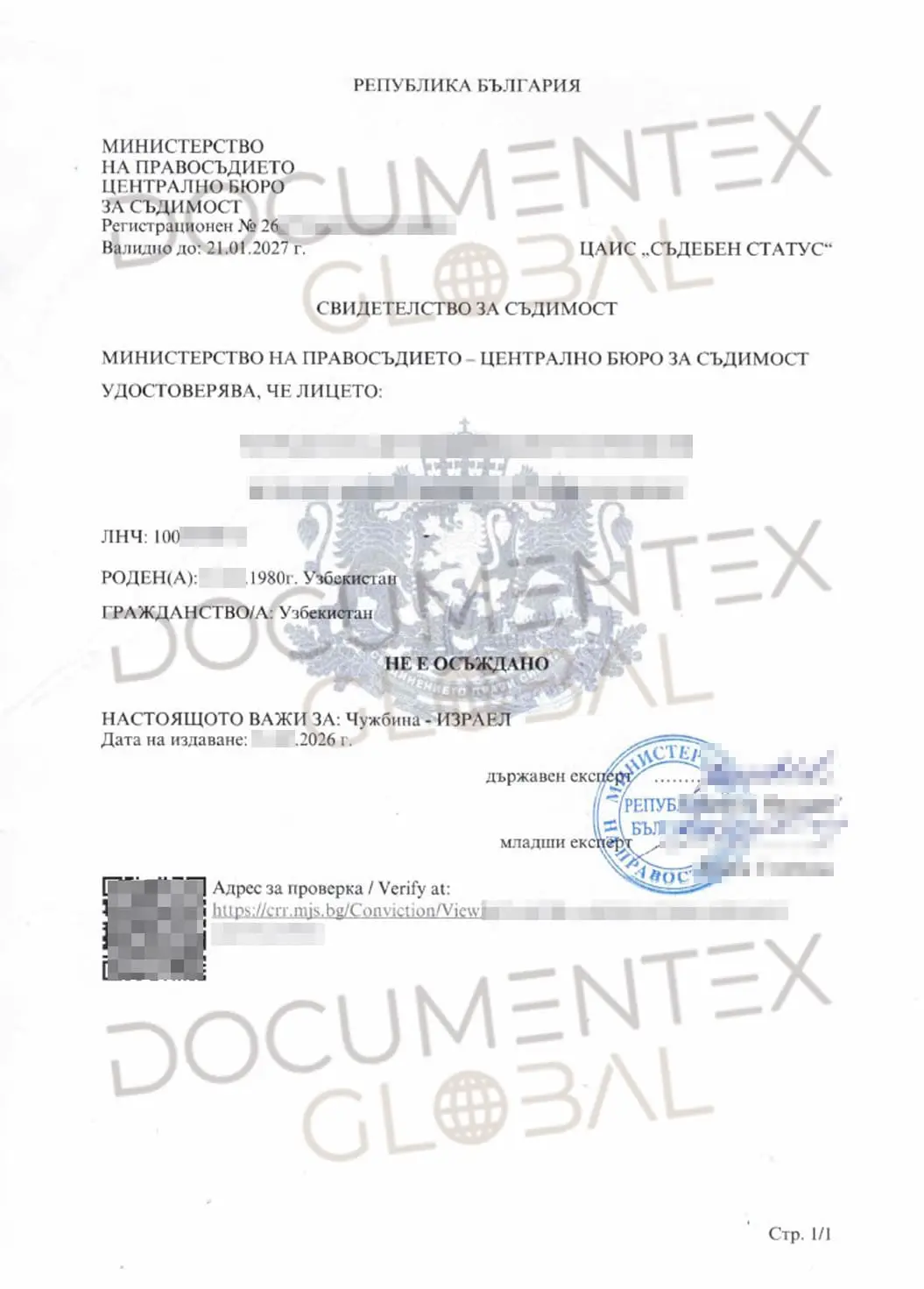
Bulgarian convictions are recorded by the judiciary, not by police departments. So when a visa officer, an employer, or a licensing board abroad asks for a Bulgarian police clearance, what they will actually get is a criminal record certificate (свидетелство за съдимост). Clerks in the criminal records bureaus (бюра за съдимост), small offices housed inside each district court (районен съд), print it, and so does the Central Criminal Records Bureau, part of the Ministry of Justice in Sofia. English-language checklists call it different things: criminal record certificate, certificate of no criminal record, police certificate, or now and then certificate of conviction status.
A Bulgarian criminal record certificate often becomes necessary only after the applicant has settled in another country. Someone who left Varna several years ago might suddenly need one for a residence application, while a former foreign resident could be asked for the same paperwork by an overseas employer. In either case, the request concerns a period spent in Bulgaria, even though the applicant now lives elsewhere.
Who Issues the Bulgarian Criminal Record Certificate
For years, the place where someone was born determined which criminal records office handled the application. Someone born in Ruse would normally approach the bureau attached to the local court. People whose birthplace was outside Bulgaria, or could not be established, were directed instead to the Central Criminal Records Bureau (Централно бюро за съдимост) at the Ministry of Justice. This distinction mattered particularly to applicants who had moved away from their hometown and no longer had a practical reason to return there.
That link to the birthplace has largely gone. Data from all 113 bureaus was merged into one automated database, and under the current rules a request may be lodged with any district court bureau or with the Central Bureau directly. When someone born in Ruse applies in, say, Burgas, the Burgas clerk searches the central database and, if something is missing, asks Ruse for it.
Requests handed in at a Bulgarian embassy or consulate travel to the Central Bureau. Staff there draw up the certificate and add an apostille when the applicant has asked for one.
People also mix it up with the detailed criminal record extract (справка за съдимост), which serves courts, prosecutors, and authorized state bodies. A foreign visa officer has no use for that extract. Any checklist mentioning a Bulgarian police clearance is asking for the criminal record certificate.
What Appears on a Police Clearance Certificate from Bulgaria
On the page you will find every conviction entered in the Bulgarian register against your name. With nothing recorded, the wording reads «not convicted» (не е осъждан), or «not convicted» (не е осъждана) for a woman, meaning never convicted, and this one line is usually all a foreign immigration desk wants to see on a certificate of no criminal record.
Old sentences may drop off thanks to rehabilitation (реабилитация). Amnestied offenses and convictions after which rehabilitation took place normally stay off the certificate. The exception covers cases where, by law, rehabilitation leaves certain consequences in place; then the conviction is listed together with a note on the rehabilitation date. Anyone rehabilitated by court order should mention this on the form and enclose a copy of the ruling, instead of hoping the clerk finds it.
Bulgarian practice ties each certificate to one declared purpose. The form wants to know what the paper is for, which job if it concerns employment, and which state if it leaves Bulgaria. Visa cases must be labeled as visa cases. Order a certificate «for work in Bulgaria» and try to submit it to Canadian immigration, and you will probably be ordering again, so check that line carefully.
Three Ways to Obtain Police Clearance from Bulgaria While Living Abroad
Online, with a Bulgarian electronic identity. Holders of Bulgarian citizenship can file on the Ministry of Justice portal and sign with a qualified electronic signature or other e-identification Bulgaria recognizes. Originally only Bulgarian-born applicants with spotless records could go this way; today that filter is gone. Legally, the e-certificate carries the same weight as its paper twin. When it is meant for another state, that state is named, and a Central Bureau lawyer puts a signature on it. Non-citizens have no access to this route.
Through a Bulgarian embassy or consulate. Consular sections take requests from Bulgarians in their district and, at many missions, from foreigners who once lived in Bulgaria. You come in person, bring an original passport or ID card, and sign the form there. Foreigners are commonly told to add a birth certificate with a Bulgarian translation listing both parents, because the bureau matches records partly by parents’ names. Each mission sets its own fees, payment options, and turnaround; if the apostilled original must be shipped back from Sofia, the shipping alone may take longer than the issuing.
Through an authorized representative in Bulgaria. A spouse, parent, child, or sibling may file with an explicit written authorization. Anyone outside that circle needs an explicit power of attorney whose signature a notary has certified, though a lawyer can rely on an ordinary written one. If you sign the authorization in Canada, Germany, or anywhere else outside Bulgaria, expect the bureau to want it apostilled or legalized and rendered into Bulgarian first.
Whichever channel you use, the form asks for the same core data:
-
Full names in Cyrillic and Latin script, in the order shown in your identity document;
-
Personal identification number (ЕГН), or foreign resident identification number (ЛНЧ);
-
Date and place of birth;
-
Full names of both parents;
-
Citizenship and current address;
-
Purpose of the certificate and, for use abroad, the country.
How Long a Bulgarian Criminal Record Check Stays Valid
Bulgarian law gives paper and electronic versions a six-month life, counted from the issue date. Receiving countries keep their own clocks, some stricter than six months, so ordering too early can backfire; plan around the day your file will be lodged.
The bureau rarely holds things up. Paper versions are typically handed over on the spot or within three working days, while the e-version follows within three working days once payment clears. Applicants abroad lose most time elsewhere: consular mail, apostille, translation, and courier transit. Every certificate also bears a QR code for verification, and one lacking that code, or carrying a code that does not match the register, has no legal value.
Apostille and Translation for a Bulgarian Certificate of No Criminal Record
A Bulgarian criminal record certificate may be ready to collect, but that does not necessarily mean it is ready for the institution abroad. The next step depends on where it will be presented. A person applying for residence in Canada may receive different instructions from someone submitting the same type of certificate to an authority in another EU country.
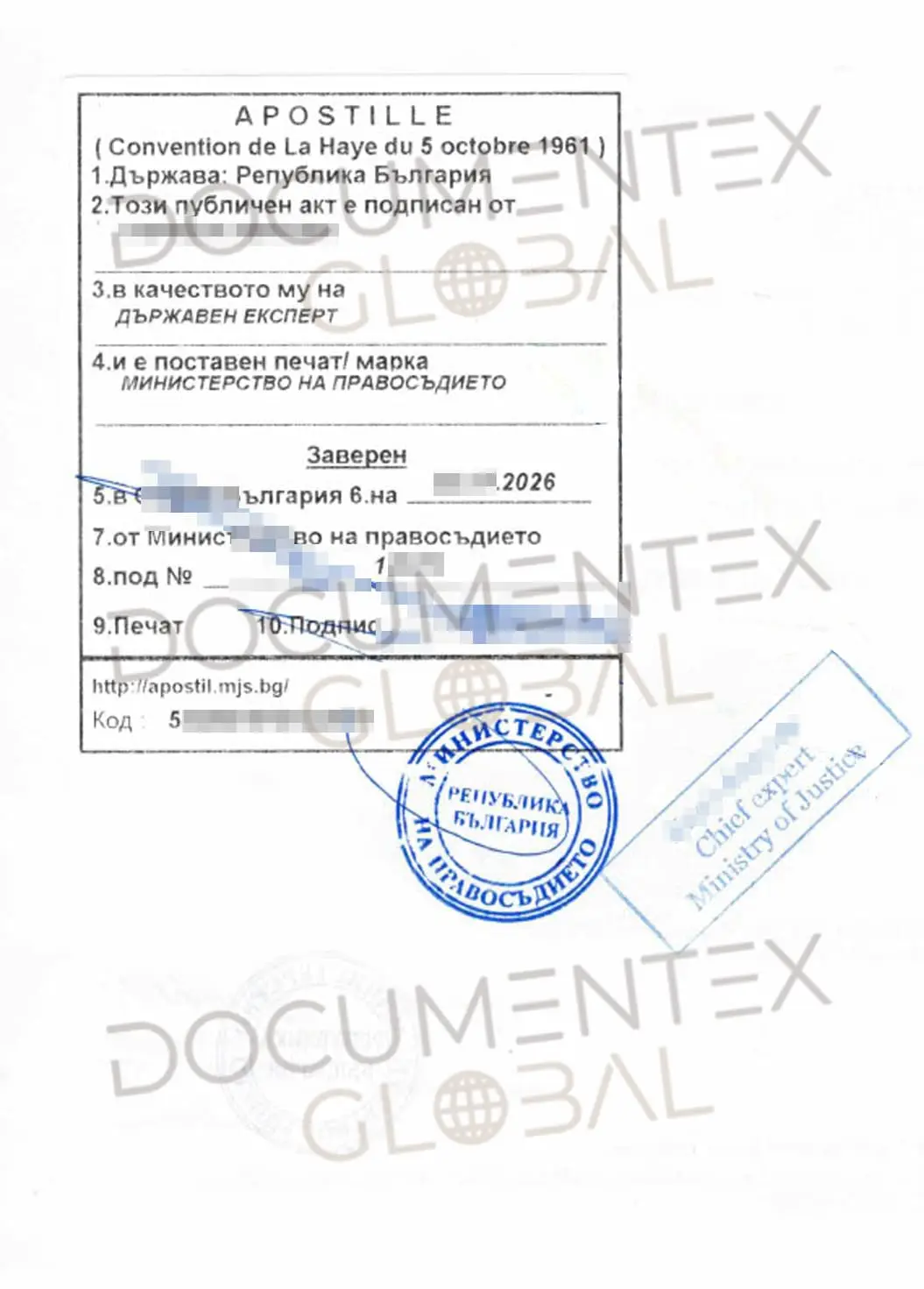
For destinations where the Hague Apostille Convention applies, the receiving office may request an apostille on the certificate. Bulgaria has participated in the Convention since 2001. The Ministry of Justice is responsible for apostilles on eligible court documents, including criminal record certificates issued through the relevant judicial authorities. The authentication concerns the official signature and seal, not whether the information recorded about the applicant is correct.
There is no reason to arrange that certification before checking the foreign authority’s requirements. Some institutions want the original certificate with an apostille attached. Others specify a recent issue date or a particular form of translation. An apostille will not resolve either of those separate requirements.
A different route is needed when the destination does not accept apostilles under the Convention. The document may have to undergo consular legalization instead, with the Bulgarian certification stage followed by the procedure required by the destination country’s embassy or consulate. The applicable sequence should be confirmed before the original is prepared.
Within the European Union, the rules can be simpler. Regulation (EU) 2016/1191 removes the apostille requirement for qualifying public documents concerning the absence of a criminal record, subject to its conditions. A multilingual standard form may also be available to help the receiving authority understand the certificate. That form does not automatically eliminate every translation requirement, so it is still worth checking what the particular office accepts.
Translation raises a separate question. The certificate’s standard text is in Bulgarian, and an employer or immigration authority overseas may require a certified or sworn translation. Some receiving offices accept a translation prepared in Bulgaria, while others ask for one completed by a translator recognized in their own country. Where both an apostille and translation are required, arranging the authentication first allows the translator to include the apostille in the finished document.
Bulgarian Criminal Record Certificate Without Travel, with Documentex Global
Clients who cannot get to Bulgaria can have their criminal record certificate (свидетелство за съдимост) obtained by Documentex Global. Our team works out which channel suits your citizenship and paperwork, fills in the purpose and destination state correctly, and explains each step of the power of attorney if a representative is going to file. Depending on where the certificate is headed, we also arrange the apostille or consular legalization, a certified or sworn translation, and international courier delivery of the original documents.
Send us the destination country and your submission deadline, and our team will map out a schedule that works backward from that date.
About Us
Documentex Global is a professional service specializing in document assistance for people living abroad or going through immigration processes

Minimal Client Involvement

No Personal Presence Required

Save Time and Resources

Reliability and Trust

Worldwide Delivery

Trusted by Our Clients
How It Works
Request
Consultation
Payment
Processing
Document Verification
Delivery
* Delivery costs are covered by the client
FAQ