Apostille for Polish Documents | Apostille Poland for International Use
A Polish birth certificate, university diploma or court record may be accepted without difficulty in its country of origin. Presenting the same paperwork abroad is another matter. The receiving institution might ask for an apostille before proceeding with an application.
We help clients obtain an apostille for Polish documents remotely, without having to visit government offices themselves. Our work covers the practical arrangements in Poland, from checking the available paperwork to dealing with the relevant institution.
If further preparation is needed, translation and international courier delivery of the originals can also be arranged.
Apostille for Polish Documents: What Does It Confirm?
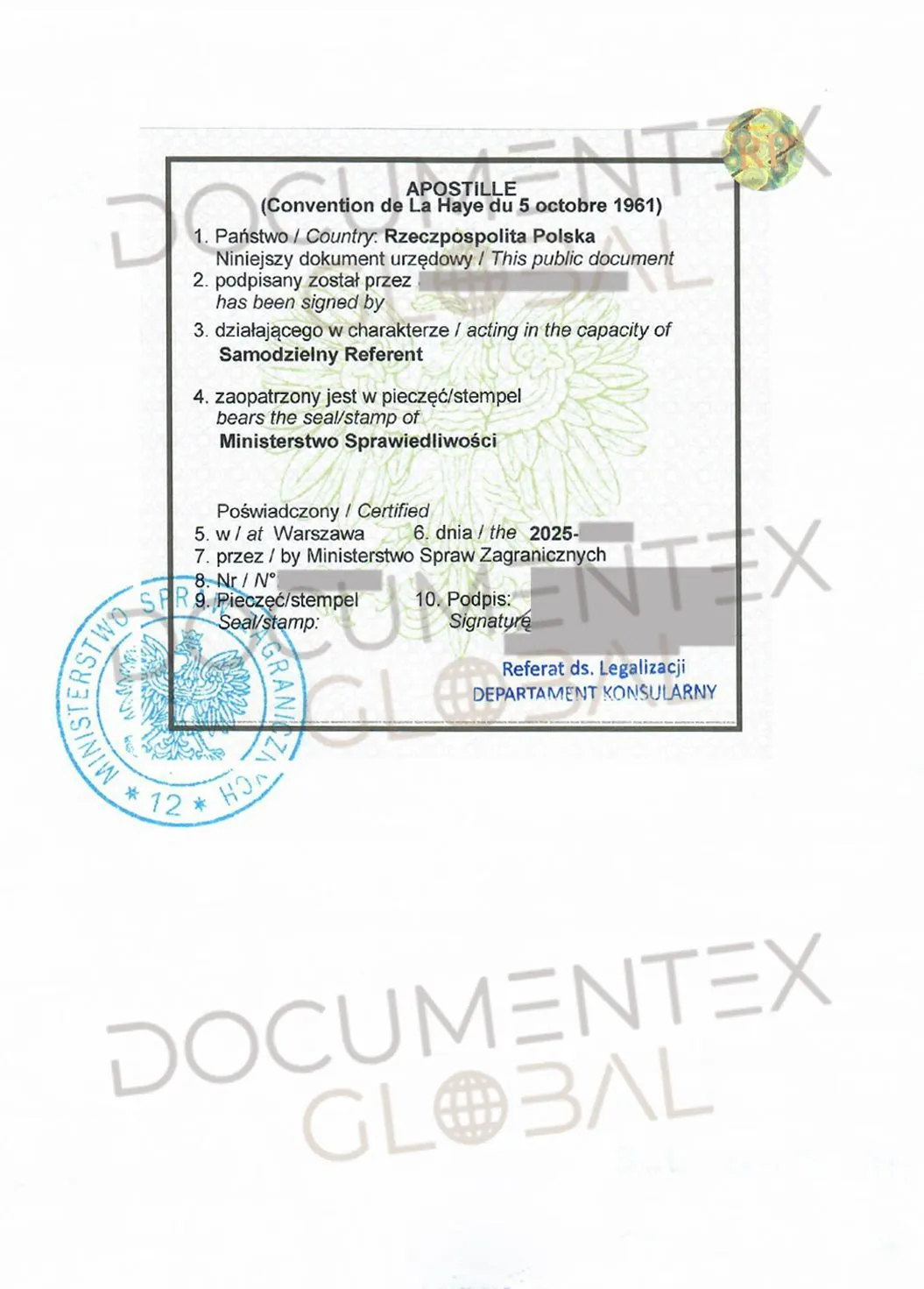
An apostille in Poland provides official authentication for public records intended to be presented in another country.
Its purpose is quite specific. It verifies the signature of the official who signed the paper, that person’s official capacity and, where applicable, the authenticity of the seal or stamp.
It says nothing about whether the information contained in the underlying record is correct.
The Hague Convention of 1961 introduced this simplified method of authentication. Where it applies between the countries concerned, the traditional chain of consular legalization is generally unnecessary.
There are exceptions worth checking before starting. Certain public records circulate internationally under agreements that remove the need for an apostille altogether. Others may still require consular legalization because the Convention does not apply to the particular destination.
The right approach therefore depends on more than the country where the paperwork originated.
When Is an Apostille from Poland Required?
Moving abroad often means dealing with paperwork that was issued years earlier. A Polish university diploma may suddenly be needed for a job application in another country. A birth or marriage record might be requested by a foreign civil registry. In both situations, the institution receiving the papers decides what authentication it expects.
An apostille for documents from Poland is commonly associated with:
-
Immigration, residence permits and citizenship;
-
Marriage registration outside Poland;
-
University admission and recognition of qualifications;
-
Employment or professional licensing;
-
Inheritance and family-related proceedings;
-
Court cases involving foreign authorities;
-
Business registration and other official matters.
There is no universal rule requiring an apostille for every Polish record used overseas.
Take civil status documents within the European Union. Under EU rules, certain public records can be presented in another member state without an apostille. This exemption has limits, however, and does not extend automatically to university qualifications, commercial paperwork or every other category.
Outside the EU, the answer may be different again.
We therefore look at the intended destination before arranging authentication. Sometimes the answer is straightforward; in other cases, the type of record and the purpose for which it is being presented both matter.
Which Documents Can Be Apostilled in Poland?
Apostille certification is available for various Polish public records. The important point is that they do not all pass through the same administrative system.
The types we commonly deal with include:
-
Birth certificates (Akt urodzenia), marriage records and other extracts from the civil registry;
-
Criminal record certificates (Zaświadczenie o niekaralności) from the National Criminal Register (Krajowy Rejestr Karny, KRK);
-
University diplomas, degree certificates and supplements;
-
School-leaving and examination certificates;
-
Notarial deeds, powers of attorney and certified declarations;
-
Judgments and other court-issued records;
-
Selected papers originating from public administration.
A civil registry extract and a university diploma may both be intended for the same immigration application, yet the route to authentication can be entirely different.
The situation becomes more complicated with notarial and judicial papers. In some cases, a signature needs to be authenticated before the final apostille stage can begin.
We also pay attention to the version being presented. A photocopy is not the same as an original, and a printed electronic file does not automatically have the status of a paper record eligible for this procedure.
That distinction is worth resolving at the beginning. Otherwise, a client may spend time preparing a version that the competent office cannot accept.
Who Issues an Apostille in Poland?
In Poland, the answer depends on what kind of paperwork you have. It is not always a matter of taking everything to the same office in Warsaw.
For many standard public records, the competent institution is the Ministry of Foreign Affairs (Ministerstwo Spraw Zagranicznych, MSZ). Its responsibilities include numerous civil status records and eligible criminal record certificates.
University qualifications are a different case. The National Agency for Academic Exchange (Narodowa Agencja Wymiany Akademickiej, NAWA) handles apostilles for designated higher education credentials, including diplomas and supplements.
School paperwork has its own arrangements. Depending on the qualification, the competent body may be a regional education superintendent (kurator oświaty), an examination board or the relevant education ministry.
Documents from certain art schools fall within the responsibilities of the Ministry of Culture and National Heritage.
Court and notarial records require a separate check. Some must first undergo authentication by the president of the competent regional court (sąd okręgowy) before they can proceed to the Ministry of Foreign Affairs.
This is why we ask where the record came from before discussing the application itself.
Two people may both need an apostille for use abroad, but if one holds a university diploma and the other a notarized power of attorney, the administrative work may be quite different.
Identifying the correct route early helps avoid unnecessary visits, rejected applications and delays caused by missing preliminary authentication.
Preparing Polish Documents for an Apostille
The paperwork available to a client is not always the version that should be presented for authentication.
Someone who left Poland several years ago might still have a birth certificate issued long before their current immigration application. That certificate may remain valid, but the foreign institution could insist on a more recent extract.
In such a case, obtaining a new civil registry record comes before arranging the apostille.
A university diploma raises different questions. We need to know which institution issued it and whether it falls within the category handled by NAWA or another competent body.
For notarial papers, the signature and any preliminary authentication also deserve attention.
We examine these details before arranging the Polish part of the procedure. There is little benefit in approaching an office with paperwork that is not yet suitable for processing.
If a new official record is needed, assistance with obtaining it can be organized separately. Once the correct version is available, we can move forward with the appropriate institution.
Apostille and Translation of Documents from Poland
An apostille and a translation are not interchangeable.
One authenticates the official origin of the paperwork. The other makes its contents understandable to the organization examining it.
For some overseas applications, a sworn translation is necessary. In other cases, a certified translation is accepted, or the receiving institution may not ask for one at all.
The order of these formalities can also matter. A translation prepared before authentication is not automatically the right choice for every destination.
We therefore check the language and certification requirements together, rather than treating them as two unrelated services.
Where appropriate, apostille and translation of Polish documents can be coordinated within the same order.
Remote Apostille Service in Poland
Living abroad can make a relatively straightforward administrative task inconvenient. The original may be in one city, the competent office in another, and the completed paperwork needed somewhere entirely different.
Our role is to organize the work in Poland while the client remains overseas.
Depending on the case, this may involve:
-
Reviewing the existing originals and their intended use;
-
Locating the correct institution;
-
Establishing whether preliminary authentication is needed;
-
Arranging the application locally;
-
Following the paperwork through the relevant stages;
-
Coordinating sworn or certified translation;
-
Organizing international courier delivery once everything is ready.
Not every order involves all these steps.
A single civil registry extract may be relatively straightforward. Several papers originating from universities, courts and notaries may require different routes before they can be prepared for the same overseas application.
We organize the work according to the actual requirements of each case.
Obtain an Apostille for Polish Documents Without an In-Person Visit
If you need an apostille for Polish documents while living outside the country, you can often arrange the procedure without travelling back.
We start with the type of record, its current form and the country where it will be presented. These details help determine the responsible office and whether any additional authentication is necessary.
The administrative stages can then be coordinated locally. If the receiving institution also asks for a translation, that work can be included.
After completion, we arrange international courier delivery of the original documents with the apostille, so you can receive the finished paperwork abroad without making a separate trip to Poland.
About Us
Documentex Global is a professional service specializing in document assistance for people living abroad or going through immigration processes

Minimal Client Involvement

No Personal Presence Required

Save Time and Resources

Reliability and Trust

Worldwide Delivery

Trusted by Our Clients
How It Works
Request
Consultation
Payment
Processing
Document Verification
Delivery
* Delivery costs are covered by the client
FAQ